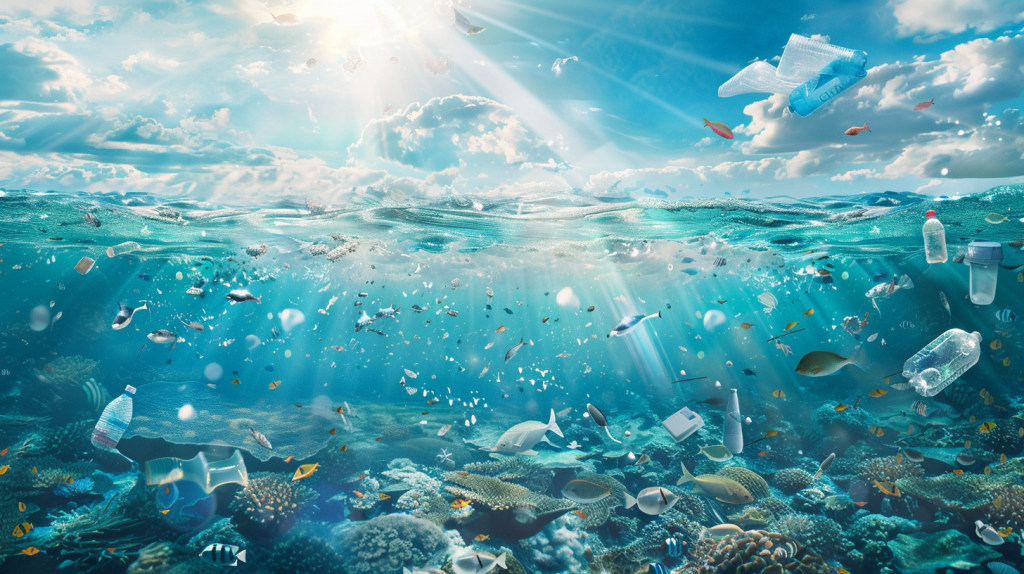
It’s estimated that about 8 million tons of plastic waste enter the ocean every year.
A single disposable cup, which we casually throw away, can become the start of a tragedy -one that threatens the entire marine ecosystem.
Once in the ocean, plastic waste is broken down by sunlight and waves.
Strong ultraviolet rays and ocean currents break down large pieces into smaller fragments, less than five millimeters in size.
These are called microplastics.
Because plastic doesn’t biodegrade, these particles can float in the ocean for hundreds of years, traveling across the world’s seas.
Marine animals often mistake them for food.
From microscopic plankton to giant whales, every creature is exposed to this invisible threat.
Scientists have even found microplastics inside the stomachs of fish sold in local markets.
That means this problem is not far away – it’s already part of our daily lives.
The danger grows as microplastics move up the food chain.
Plankton eat them first.
Then small fish eat the plankton, bigger fish eat the small fish, and finally seabirds — and humans — eat the larger predators.
At each step, the concentration of plastic and toxins increases.
Eventually, this cycle comes back to us.
Research shows that microplastics can enter our bodies through the seafood we eat.
What started as ocean pollution now reaches our own plates.
The time for simply saying “recycle” is over.
We need deeper, fundamental solutions — reducing unnecessary plastic use, developing eco-friendly materials, and making a shared effort to protect our planet.
Every piece of plastic we throw away has a story.
The question is: where will that story end?
임은미 | 브릿지프레스 발행인